NAR: New York Metro Region Posted Ninth Highest Home Price Increase in First Quarter at 18.4%
WASHINGTON—More than 90% of metro markets (205 out of 221, or 93%) posted home price gains in the first quarter of 2024, as the 30-year fixed mortgage rate ranged from 6.60% to 6.94%, according to the National Association of Realtors’ latest quarterly report released today (May 8). Thirty percent of the 221 tracked metro areas experienced double-digit price gains over the same period, up from 15% in the fourth quarter of 2023.
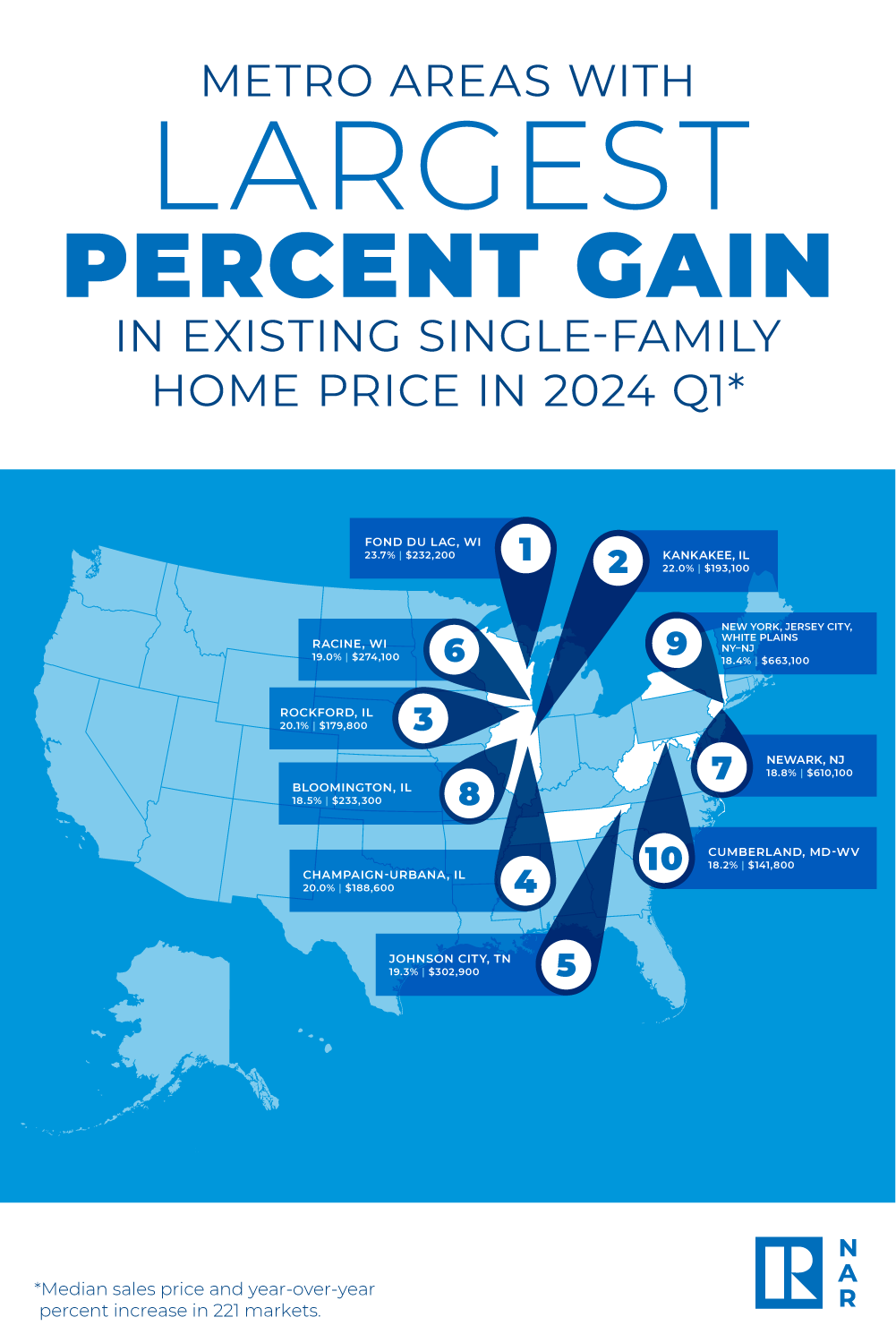
The top 10 metro areas with the largest year-over-year median price increases, which can be influenced by the types of homes sold during the quarter, all registered gains of at least 18.2%. Six of the markets were in Illinois and Wisconsin. Overall, those markets were Fond du Lac, WI (23.7%); Kankakee, IL (22.0%); Rockford, IL (20.1%); Champaign-Urbana, IL (20.0%); Johnson City, TN (19.3%); Racine, WI (19.0%); Newark, NJ-PA (18.8%); Bloomington, IL (18.5%); New York-Jersey City-White Plains, NY-NJ (18.4%); and Cumberland, MD-WVA (18.2%).
“Astonishingly, greater than 90% of the country’s metro areas experienced home price growth despite facing the highest mortgage rates in two decades,” said NAR Chief Economist Lawrence Yun. “In the current market, rising prices are the direct result of insufficient housing supply not meeting the full demand.”
Compared to one year ago, the national median single-family existing-home price climbed 5% to $389,400. In the prior quarter, the year-over-year national median price increased 3.4%.
Among the major U.S. regions, the South registered the largest share of single-family existing-home sales (46%) in the first quarter, with year-over-year price appreciation of 3.3%. Prices also swelled 11% in the Northeast, 7.4% in the Midwest and 7.3% in the West.[1]
Eight of the top 10 most expensive markets in the U.S. were in California. Overall, those markets were San Jose-Sunnyvale-Santa Clara, CA ($1,840,000; 13.7%); Anaheim-Santa Ana-Irvine, CA ($1,365,000; 14.2%); San Francisco-Oakland-Hayward, CA ($1,300,000; 14%); Urban Honolulu, HI ($1,085,800; 5.5%); San Diego-Carlsbad, CA ($981,000; 11.5%); San Luis Obispo-Paso Robles, CA ($909,300; 7%); Oxnard-Thousand Oaks-Ventura, CA ($908,700; 7.6%); Salinas, CA ($899,200; 4.1%); Naples-Immokalee-Marco Island, FL ($850,000; 9.4%); and Los Angeles-Long Beach-Glendale, CA ($823,000; 10.2%).
“The expensive markets in the West, where home prices declined last year, are roaring back,” Yun said. “Price dips in that region were viewed as second-chance opportunities by many buyers.”
Seven percent of markets (15 of 221) experienced home price declines in the first quarter, down from 14% in the fourth quarter of 2023.
Housing affordability improved in the first quarter as mortgage rates declined. The monthly mortgage payment on a typical existing single-family home with a 20% down payment was $2,037, down 5.7% from the fourth quarter of 2023 ($2,161) but up 9.33%—or $173—from one year ago. Families typically spent 24.2% of their income on mortgage payments, down from 26.1% in the prior quarter but up from 23.3% one year ago.
Once again, first-time buyers faced limited inventory and elevated home prices in the first quarter, though affordability conditions bettered from the previous quarter. For a typical starter home valued at $331,000 with a 10% down payment loan, the monthly mortgage payment fell slightly to $1,998, down 5.7% from the previous quarter ($2,118). However, that was an increase of $168, or 9.2%, from one year ago ($1,830). First-time buyers typically spent 36.5% of their family income on mortgage payments, down from 39.3% in the prior quarter.
A family needed a qualifying income of at least $100,000 to afford a 10% down payment mortgage in 40.7% of markets, down from 47.1% in the previous quarter. Yet, a family needed a qualifying income of less than $50,000 to afford a home in 4.5% of markets, up from 2.3% in the prior quarter.